Push piers vs helical piers
Both systems carry a settling house down to soil that will not move, and both are made of steel. They differ in how they get there, what they need from the house, and the kinds of jobs they suit best.
What both systems do
A settling house has footings resting on soil that is shrinking, swelling, washing out or simply too weak. Both pier systems bypass that soil. A steel shaft goes down beside or under the footing to a deeper layer that can carry the weight, and a steel bracket transfers the load from the footing to the shaft. After that, the clay near the surface can keep changing without moving the piered section of the house.
Push piers in detail
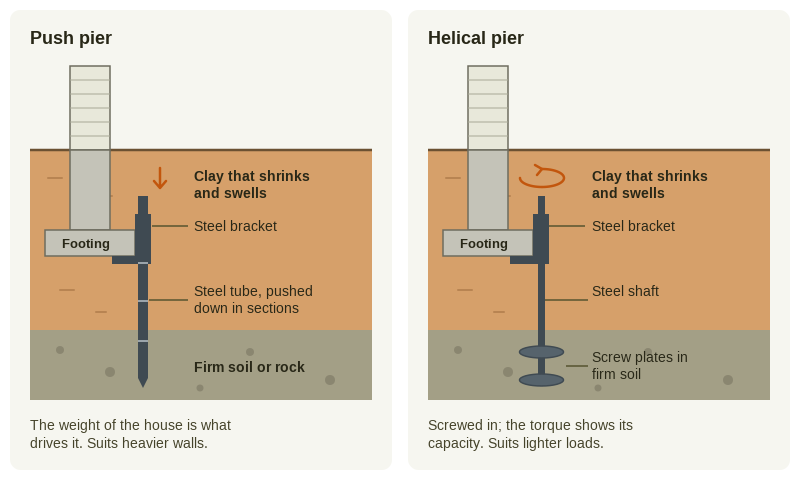
A push pier, also called a resistance pier, is a series of steel tubes, each a few feet long, driven into the ground one after another by a hydraulic ram. The ram pushes down on the tube while pushing up on a bracket fastened to the footing, so the house itself is the counterweight. As each section goes down, the next is added on top.
The ram keeps driving until the ground below pushes back harder than the pier will ever be asked to carry, which means the pier has reached soil or rock that can bear the load. Because the gauge reading at that point reflects real resistance in the ground, every push pier is effectively load-tested as it is installed. Many systems add a friction-reducing collar at the tip, so the reading reflects the bearing layer rather than friction along the shaft.
Once all the piers are in, the load is transferred to them together, and the house can be lifted using the same brackets.
Helical piers in detail
A helical pier starts with a lead section, a steel shaft with one or more screw-shaped plates near the tip. A hydraulic torque motor turns it into the ground, and extension sections are added as it goes deeper. The plates pull the pier down like a screw, so it does not need the weight of the house to install.
The torque needed to keep turning rises as the plates reach firmer soil. Manufacturers publish how installation torque relates to capacity, so the installer turns each pier until it reaches the torque that corresponds to the load it must carry, and records the final reading.
Helical piers can carry load immediately and can be installed with fairly compact equipment, which makes them useful in tight spaces and for new construction as well as repairs.
Side by side
| Push piers | Helical piers | |
|---|---|---|
| How they go in | Driven by a hydraulic ram | Screwed in by a torque motor |
| What drives them | The weight of the house | Rotation and torque |
| How capacity is checked | Hydraulic pressure at refusal | Installation torque |
| Best suited to | Heavy walls, two-story and brick houses | Light loads, porches, slabs, additions |
| Needs heavy weight above | Yes | No |
| Depth decided by | Resistance in the ground | Reaching the target torque |
| Can lift the house | Yes | Yes |
Which suits common Triangle jobs
- A settled corner of a two-story brick house: usually push piers, since there is plenty of weight to drive them.
- A front porch or stoop pulling away: usually helical piers, because a porch is too light to drive push piers.
- A leaning chimney: either, depending on the chimney’s weight and access; helical piers are common.
- Interior slab sections: often helical piers, installed through openings cut in the floor.
- Crawl space perimeter walls: often push piers, installed from outside beside the footing.
- New additions or decks on clay: helical piers, installed before the structure is built.
Depth in the Triangle
Across much of the Piedmont, the soil profile runs from clay near the surface into soft, weathered rock and then harder rock, but the depth of each layer changes from lot to lot. In the Triassic basin, the sedimentary rock and its weathered layers vary too. That is why neither system has a fixed depth: push piers stop at refusal and helical piers at their target torque, wherever that happens to be on your lot. A pier log recording each pier’s depth and final reading is the proof that every one reached stable ground.
Cost
National cost guides put installed piers of either type at roughly $1,000 to $3,000 each. Depth, access and the number of piers move the price far more than the choice of system. The foundation repair cost guide has more.
What to ask a contractor
- Which system do you recommend for my house, and why?
- What pier size, and what working load will each pier carry?
- How far apart will the piers be, and where exactly will they go?
- What pressure or torque will each pier be installed to?
- Will I get a pier log with every pier’s depth and final reading?
- Will the house be lifted, and by how much?
- Is the steel galvanized?
- Is there an engineer involved, and will there be a permit?
- What does the warranty cover, and does it transfer?
Corrosion and lifespan
Pier steel is usually galvanized to resist corrosion, and the soils in most of the Triangle are not especially aggressive to steel. Ask what coating the system uses and whether the manufacturer publishes a design life. A properly installed and protected steel pier is intended to last as long as the house.
The bottom line
The right system is the one that suits the load on that part of your house, the soil underneath and the access available. Many good contractors install both and choose job by job. Be wary of anyone who recommends the same answer for every house. For the bigger picture, see foundation piers, house leveling and the foundation repair guide.
Push piers vs helical piers — common questions
Which is stronger, a push pier or a helical pier?
Neither is stronger in general. Capacity depends on the pier size, the soil and how it was installed. Push piers are proven against the weight of the house; helical piers against installation torque. Both can carry typical residential loads.
Are concrete piers an alternative?
Pressed concrete pilings and poured concrete piers are used in some regions, usually for shallower support. Steel push and helical piers can reach deeper, more stable soil, which matters on expansive Triangle clay.
Can piers be added later if more of the house settles?
Yes. Piers support only the section they are installed under. If another section settles later, it can be piered separately, which is one reason good drainage around the whole house matters.
More foundation repair guides
Want the house looked at?
Call and describe the cracks, floors or doors that worry you, or use the form and a local pro will be in touch.