Clay soils and foundations in the Triangle
Triangle soil is famous for its red clay, and clay is behind most foundation movement here. Some of it barely moves; some of it, especially in the Triassic basin, swells and shrinks enough to crack a house.
Why clay moves
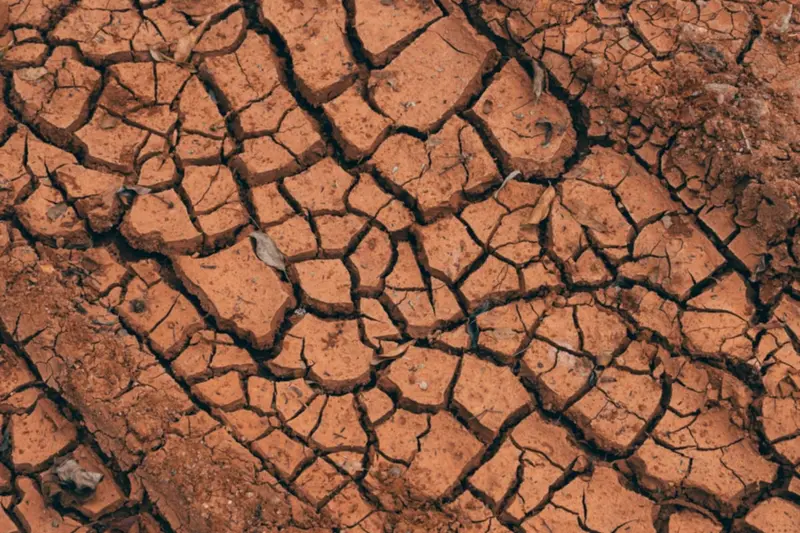
Clay is made of extremely fine, plate-shaped particles. Some clay minerals can take water in between their layers and swell, then give it up and shrink. Soils rich in those minerals change volume noticeably with the seasons, while clays made mostly of other minerals, such as kaolinite, change much less. Soil scientists rate this as shrink-swell potential, and the USDA publishes the rating for each soil type it maps.
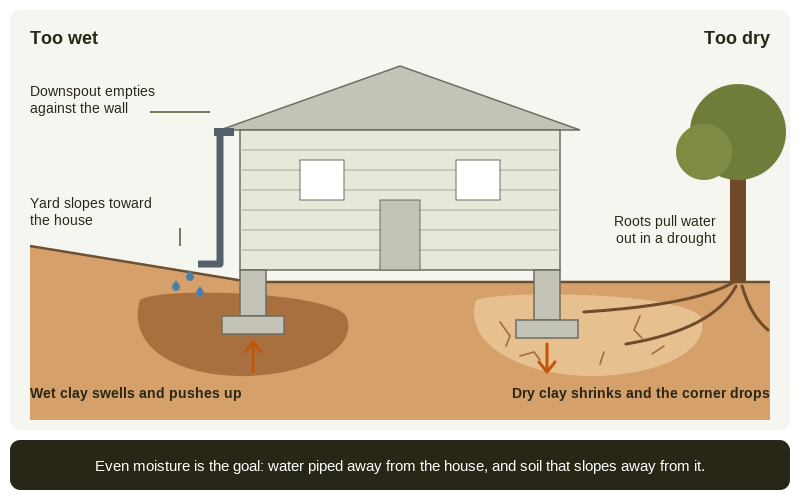
When expansive clay under a footing swells, it can lift that part of the house. When it shrinks, the footing drops into the space left behind. The house is rigid, and the soil changes unevenly, so walls crack and floors tilt.
The active zone
Moisture in the soil changes most near the surface, where rain soaks in, roots draw water out and the sun dries the ground. Engineers call the depth over which clay moisture changes with the seasons the active zone, and it reaches down several feet in expansive soils. Most house footings in the Triangle sit within the top couple of feet, inside that zone, which is why they ride up and down with it, and why piers that reach below it stop the movement.
The Triassic basin
About 220 million years ago, as the supercontinent Pangea began to split apart, rift valleys opened across what is now the Piedmont and filled with sediment eroded from the land on either side. North Carolina has three of these Triassic basins. The largest, the Deep River basin, reaches into parts of 11 counties, including Wake, Durham and Chatham, according to the North Carolina Geological Survey. Its Durham sub-basin runs from Durham southwest through the Research Triangle Park and Morrisville toward Sanford, and a railroad cut in Morrisville exposes its conglomerate rock.
The sandstone, siltstone and mudstone of the basin weather into clay-rich soils that drain slowly. The Geological Survey notes that these soils often perform poorly in percolation tests for septic systems, and the same slow drainage keeps water sitting against foundations. Several soil types that form here are rated high or very high for shrink-swell by the USDA, including the White Store and Creedmoor series. The Green Level series, another Triassic basin soil with very high shrink-swell rated in part of its subsoil, has its reference site along US 64 in western Wake County.
Outside the basin
East of the basin, past the Jonesboro fault, most of the Triangle sits on older crystalline rock: granite, gneiss and schist. These weather into the familiar red clay and the softer, crumbly rock beneath it, which builders call saprolite. Much of that red clay is only mildly expansive and makes a decent foundation soil when it is kept evenly moist. Scattered areas over darker, iron-rich rock, and around the diabase dikes that cut through the region, can weather into stickier, more expansive clay.
So two houses a few miles apart can sit on very different ground, and even one subdivision can include several soil types.
Fill and graded lots
New subdivisions are graded before houses are built: soil is cut from high ground and pushed into low ground and old stream valleys. Fill that is placed in thin layers and compacted properly behaves well; fill that was dumped and smoothed keeps settling for years. A house that straddles cut and fill sits partly on undisturbed ground and partly on fill, and can settle unevenly. The strip of backfill around every foundation adds another layer of loose soil, which is why patios and steps beside houses so often sink.
Wet years and dry years
Triangle weather swings between extremes: summer thunderstorms that drop inches of rain in an hour, tropical storms in late summer and fall, and occasional droughts that dry the ground deeply. Foundation movement often appears after a big swing in either direction, such as a dry summer followed by a very wet fall. Cracks that open in a drought and close again after heavy rain are a sign of seasonal shrink and swell.
Trees and clay
Large trees draw a great deal of water out of the soil, and their roots usually spread well beyond the branches. In a dry summer, a willow oak, maple or other big tree close to the house can shrink the clay under the nearest corner. Removing a large tree near a house can cause the opposite problem, as the clay slowly rehydrates and swells over the following years. Either way, decisions about big trees near a foundation are worth making with an arborist and, where there is already movement, an engineer.
How to check your soil
- Web Soil Survey. The USDA’s free online tool maps soil types by address and lists each one’s shrink-swell rating, drainage and depth to rock.
- Builder records. Newer homes may have a geotechnical report or soil tests from construction; ask the builder or check permit records.
- The yard itself. Deep cracks opening in the lawn during dry spells, and soil that turns sticky and slick when wet, both point to expansive clay.
- A geotechnical engineer. For additions, major repairs or new construction, soil borings and lab tests give site-specific answers.
Living with clay
The goal is not to keep clay dry, but to keep its moisture steady and even all around the house:
- Pipe downspouts well away from the foundation. See foundation drainage.
- Grade the soil to fall away from the walls, about 6 inches over the first 10 feet.
- Avoid planting beds that trap water against the house, and keep sprinklers aimed away from it.
- In a long drought, water the beds around the foundation deeply and evenly.
- Plant large trees well away from the house.
- Fix plumbing leaks quickly, especially under slabs.
When the clay has already moved the house, foundation piers carry the load below the active zone, and the foundation repair guide walks through the other repairs.
Clay soils and foundations — common questions
How do I find out what soil my house is on?
The USDA's free Web Soil Survey maps soil types by address and lists properties such as shrink-swell potential. It is a general map, so a geotechnical engineer's soil tests are needed for anything site-specific.
Is red clay bad for foundations?
Not necessarily. Much of the Piedmont's red clay is only mildly expansive, and houses do well on it with good drainage. The more troublesome soils are the high shrink-swell clays, including several found in the Triassic basin.
Should I water my foundation during a drought?
In a long drought, deep watering of the beds around the foundation can keep the clay from drying and shrinking unevenly, especially near large trees. Water evenly, a little away from the wall, rather than aiming a hose at the foundation.
More foundation repair guides
Want the house looked at?
Call and describe the cracks, floors or doors that worry you, or use the form and a local pro will be in touch.