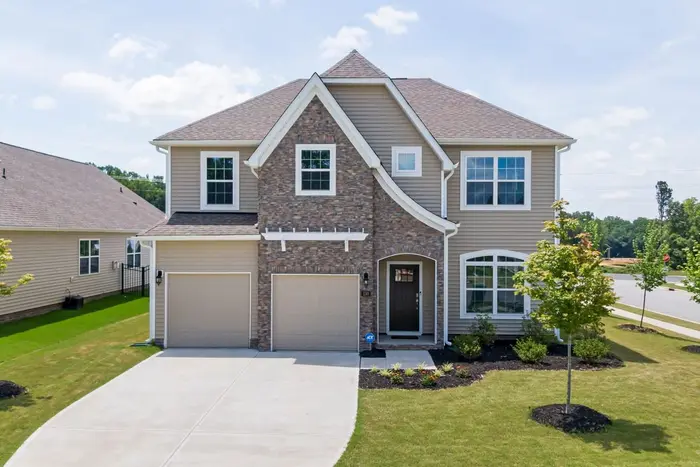
Foundation drainage in Cary, NC
Water is behind most foundation movement in the Triangle. Getting roof runoff and surface water away from the house keeps the clay under the footings at a steady moisture level, which protects the foundation and every repair made to it.
- Downspouts piped to daylight or pop-up emitters
- Yards regraded to drain away from the walls
- French drains and swales for wet lots
- Footing drains when walls are dug out
- Gutter sizing and overflow fixes
Covering Cary · Apex · Holly Springs · Morrisville · Raleigh
Get a quote for foundation drainage
Cause first, then the fix
Cracks and sticking doors are symptoms. Every visit looks for what moved the house, usually water in clay soil, before anyone talks about piers.
Measured, not guessed
Floor elevations are taken across the house with a level, so the repair plan rests on numbers you can see and compare.
A written plan and price
The number of piers, where they go, any drainage work, engineer letters, permits and the warranty, listed line by line in writing.
Why choose us
Repairs that stop the movement, not just hide it
Triangle clay swells when it is wet and shrinks when it dries, and houses ride along. Finding why the house moved, supporting it on something that does not, and fixing the water behind it are what keep a repair from failing.
- Floor elevations measured
- Push and helical piers
- Engineer-backed plans
- Drainage fixed at the source
- Written, itemized estimates
- Local to Cary
Why drainage is a foundation repair
Clay under a foundation causes the most trouble when its moisture changes, and especially when it changes unevenly. A downspout that dumps a roof’s worth of water at one corner keeps that corner’s clay swollen in wet weather and shrinking in dry spells, while the rest of the house sits on steadier ground. Over the years, that difference is what cracks walls and tilts floors.
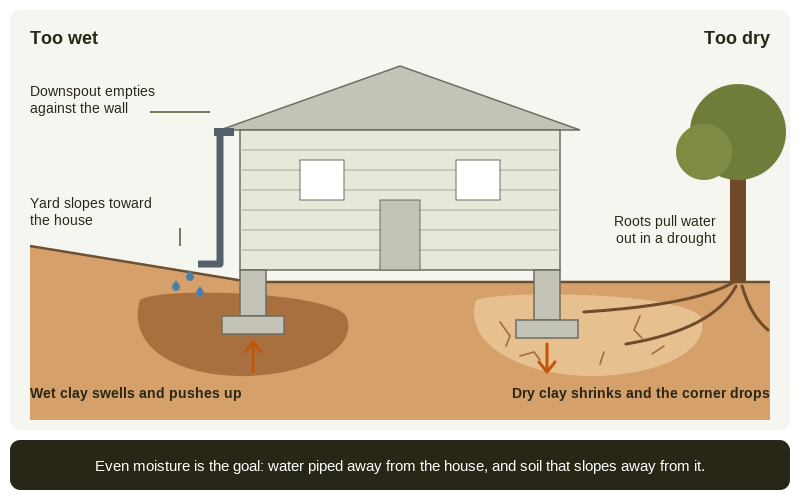
Drainage is the least expensive foundation repair there is, and the most overlooked. Piers and wall braces deal with the damage; drainage deals with the cause. The clay soils guide explains the soil side of the story.
Gutters and downspouts
A roof sheds a remarkable amount of water. An inch of rain on 1,000 square feet of roof is roughly 600 gallons, and every downspout concentrates the runoff from its share of the roof into one spot. Practical fixes:
- Gutters cleaned and kept clear, especially under pines and oaks that drop needles, leaves and pollen.
- Gutters and downspouts sized for heavy summer storms, with extra downspouts where gutters overflow at corners.
- Downspouts connected to solid buried pipe that carries water downhill to daylight, to a pop-up emitter in the yard, or to a dispersion area well away from the house.
- Extensions several feet long where burying pipe is not practical, kept in place rather than kicked aside by the mower.
Grading
The ground next to the house should fall away from it. The North Carolina residential code calls for at least 6 inches of fall in the first 10 feet where the lot allows. Over time, settling backfill, deep mulch and landscape edging often reverse that slope. Regrading with compacted soil, not mulch, restores it. Where the whole lot slopes toward the house, a shallow swale uphill can intercept the water and steer it around.
French drains and curtain drains
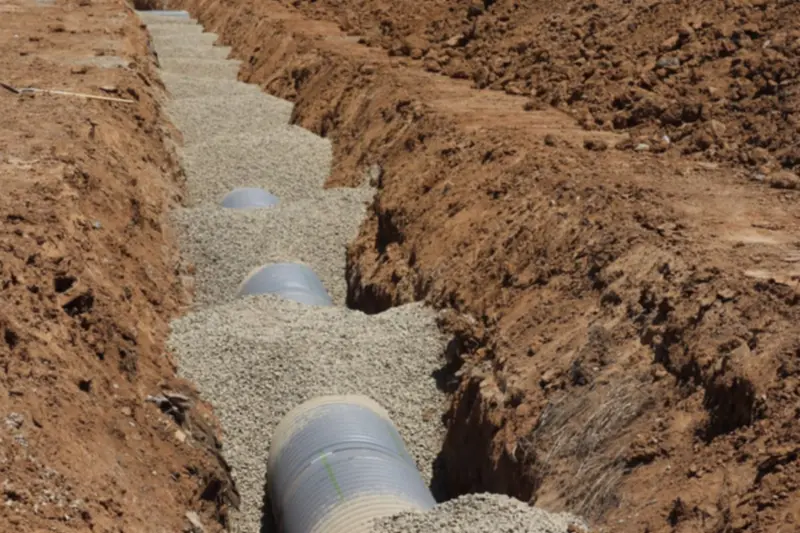
On hillside lots, and in yards where water moves through the soil toward the house, a French drain helps: a trench lined with filter fabric and filled with gravel around a perforated pipe, sloped to carry water to daylight. A curtain drain is the same idea set uphill of the house to catch water before it reaches the foundation. On clay, which drains slowly, these need a real outlet; a pipe that ends in a gravel pit in clay just fills up and sits there.
Footing drains
A drain at the base of the footing, outside the wall, is the classic way to keep water away from a basement or crawl space wall. Adding one to an existing house means excavating down the wall, so it is usually done along with wall repairs or exterior waterproofing. See basement waterproofing.
Irrigation and trees
Water also comes from sprinklers. Spray heads that soak the foundation and flower beds watered heavily against the walls keep the clay there wetter than anywhere else, so aim heads away from the house and water deeply but less often. Large trees near the house work the other way, drying the clay in summer droughts. Tree roots usually spread well past the branches, so a big willow oak a few yards from the house can shrink the clay under a corner. Root barriers, or removing a tree, sometimes belong in the plan, after an arborist weighs in.
Drainage and other repairs
Most foundation repairs include drainage work for good reason. Piers protect the piered section, but the rest of the house still sits on clay; a basement wall brace stops the wall moving, but the water pushing on it is still there. Every quote for foundation settlement repair or basement wall repair should say what will be done about water.
A rainy-day walk-around
The best drainage survey is free. Put on a raincoat during a heavy storm and walk around the house. Watch where gutters overflow, where downspouts discharge, where water pools and which way it runs across the yard. Take photos. Those few minutes show more than any dry-day inspection, and they make it easy to explain the problem to whoever fixes it.
Foundation drainage — common questions
How far should downspouts discharge from the foundation?
Farther is better on clay. A splash block at the wall is not enough. Many contractors aim for several feet at minimum, and buried solid pipe that carries the water to daylight, a pop-up emitter or a drainage area well away from the house is the most reliable answer.
What is the right slope for the soil around a house?
The North Carolina residential building code calls for the ground to fall at least 6 inches within the first 10 feet from the foundation, where the lot allows it. Where it does not, swales or drains carry the water around the house instead.
Can poor drainage really move a foundation?
Yes. Clay under a footing that gets soaked in every storm swells, then shrinks as it dries, and running water can carry soil out from under slabs and walls. Water concentrated at one corner is one of the most common causes of uneven settlement in the Triangle.
Problems this fixes
Often booked with this